Tottenham Hotspur Stadium


In one of the recent televised matches of Spurs playing at home – I forget which one – Gary Neville was commenting on the funereal atmosphere in the stadium. “It’s all so eerily quiet,” he observed, “It just doesn’t feel right.”
Now, I have not had the pleasure of attending a match at the new Tottenham Hotspur Stadium, but I do remember vividly the first ever professional football match I was taken to. It was at the old White Hart Lane Stadium and Spurs were playing Gornik from Poland in the European Cup in 1961. Spurs won by a cricket score, 8-1. The scorers were Blanchflower with a penalty, a hat-trick from Jones, two from Smith and one each from Dyson and White. I can still recite from memory the names of the great Spurs Double-winning team of the 1960-61season: Brown, Baker, Henry, Blanchflower (c), Norman, Mackay, Jones, White, Smith, Allen, Dyson. Managed by Bill Nicholson (whose daughter was briefly my girlfriend at Southampton University – but that’s another story). Jimmy Greaves came in as a record signing from Chelsea the following season. One thing always strikes me as I recall those players from the distant past. They all have basic Anglo-Saxon names, with the exception of Blanchflower, which has its antecedents in Norman French (blanche fleur, white flower or flour). Compare their names with the current Spurs team that recently played against Nottingham Forest: Vicario, Porro, Romero, van der Ven, Spence, Bentancur, Gray, Kudos, Simons, Muani, Richarlison. Not many English names there. Remember the Lisbon Lions, the Celtic side that won the European Cup in 1967? All but two of the 15-man squad were born with ten miles of Celtic Park, and the two outliers were Tommy Gemmell, who was born eleven miles away and Bobby Lennox, who was born thirty miles away. Unsurprisingly, they all had Scottish names.

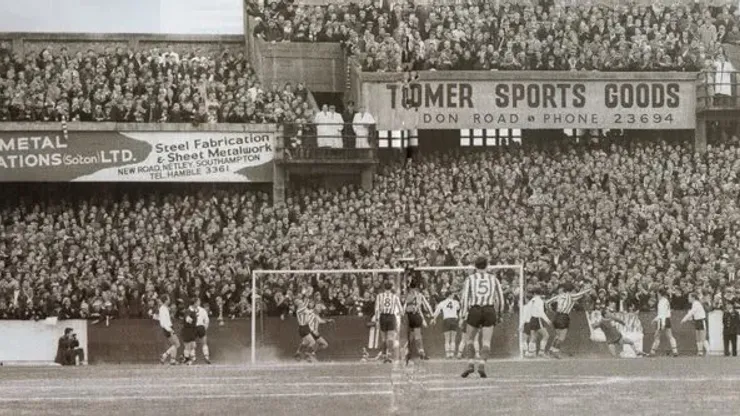
But I digress. The old stadium at White Hart Lane was rocking that night, and it left an indelible impression on my memory. To this day, nothing stirs me more than live football – though it can be cricket or rugby as well – with the crowd noisy and boisterous, and sometimes ecstatic, during an exciting match. I remember the old ground – I hesitate to call it a stadium - of Southampton at the Dell. It was an odd-shaped place, tight and compact, with the iconic wedge-shaped Milton Road Stand and the crowd practically tipping over onto the playing area. Micky Channon once told me that opponents “hated” playing there because “the fans were right on top of them.”
Some 400 yards up the road from the Dell was Northlands Road, home to Hampshire CCC, where I played for ten years. It was a ramshackle old place, with dilapidated stands, old wooden seating and in severe need of a lick of paint. But it was home and we loved playing there. Now, Hampshire has a spanking new stadium as its HQ, big and swanky enough to host Test matches with a maximum capacity of 25,000 spectators. Wonderful for international games but the 4,000 or 5,000 who turn up for a county game can get swallowed up by the cavernous, empty stands. When 4,000 spectators were crammed into our old ground for raucous semi-finals, the decrepit roof would come off, once almost literally so.

The new Tottenham Hotspur stadium is by all accounts the best in the land, possibly in Europe, a state-of-the-art edifice specially designed to create a ‘wall of sound’. As Gary Neville pointed out, that ‘wall of sound’ currently sounds conspicuously silent. If Spurs began to win a few games, the fans might become more vocal, but I rather think there’s more to it than that. Football fans, indeed all sport spectators, are by nature a conservative lot, resistant, or at least slow, to embrace change. West Ham supporters hate their new home, probably because it never was, and never will be, a football stadium (it was an athletics stadium built for the London Olympics in 2012) and yearn for a return to the old Boleyn Ground, more commonly called Upton Park in east London. (Incidentally, it was called the Boleyn Ground because Anne Boleyn lived in a nearby castle.) Arsenal fans took their time to accustom themselves to the brand-new Emirates Stadium, feeling that it did not replicate the atmosphere of the old Highbury, which, when opened in 1932, was considered to be the last word in Art Deco architecture. I think Arsenal fans have now, at last, come to recognise the Emirates as ‘home’ and make enough noise. Mind you, their team is top of the league, so the silent treatment is hardly appropriate. Think too of Anfield. The old stadium is showing signs of wear and tear, but nobody can decry the passionate support the team gets from the crowd, especially on European nights under floodlights.
There is another point to consider, one that had completely escaped me, until pointed out. I have a friend who is a committed Wolves supporter. For home games, he sits with other season ticket holders and over the years, they have all got to know each other well. The Black Country humour ebbs and flows, although this season the Black Country humour has been blacker than usual. In the old days, I’m told, fathers would hand down their ‘seat’ to their sons, who in turn would hand it down to their own sons. Thus, a sort of community was born, lasting for generations, creating a cheerful, friendly, family atmosphere. If Wolves moved to a new stadium away from Molineux, that community, that circle of friends, would be broken up and it would take time to build another, in a new and strange environment. Perhaps Spurs fans have not yet introduced themselves to their neighbours.
All sports stadiums have their own, unique ambience, depending on its location, its architecture and its demographic. Hampshire were playing against Middlesex at Lord’s and Bob Stephenson, our wicket-keeper, said to me as we crossed between overs, “Can you hear it?” I must have looked puzzled because he added, “The hum? The Lord’s Hum?” I stopped and listened. He was right. At other grounds, there would be the sound of applause, shouts for LBWs, cheers, jeers, occasional barracking, laughter from the beer tent, noise, in effect. Lord’s was different. It was the hum of conversation of thousands of people chatting to their neighbour, interspersed with the occasional pop of a Champagne cork. Over the river, at the Oval, home to Middlesex’s cousins, Surrey, the noise of the crowd was quite different. Lord’s is upper-class, white collar, picnic hampers, chilled white wine and old school ties; the Oval is working class, blue collar, hot dogs, pints of lager and no ties, school or otherwise. Lord’s boasts stylish, avant-garde architecture, save for the iconic Victorian pavilion; the Oval has vast featureless stands and a gasometer. The two sets of supporters are quite different and behave quite differently. England love playing at Edgbaston and Headingley because the Hollies Stand and the Western Terrace respectively offer rowdy, passionate home support. Other countries love playing at Lord’s because of its history, its traditions and its genteel character.

Sometimes the old venues, steeped in history and tradition and yes, occasionally crumbling infrastructure, provide the most vibrant ambience. When my two boys were younger, I used to take them along to watch Gloucester play rugby. Their home, Kingsholm, is no soaring cathedral to the game of rugby. In fact, it is tatty around the edges and distinctly down-at-heel but therein lies its allure. It has a genuine feel about it and the club’s fans prided themselves – still do, I believe – on their passionate and knowledgeable support of their team. The North Stand, which runs the length of the pitch, is noted for its low roof, housing 3,000 spectators, all standing, and is known as the ‘Shed’. The boys loved watching from the Shed. The atmosphere, impassioned, ardent, intense, but never threatening, was part and parcel of a thoroughly enjoyable spectator experience. You always got the sense that the crowd were participating in the action, not sitting back, expecting to be entertained.

A building, a palace, a cathedral, a stadium is after all just a functional structure of bricks and mortar, steel and glass, with no life of its own. It’s inanimate. What gives it life – a soul, if you like – is the people who inhabit it. Visit a cricket ground in the winter and it bears a dismal aspect, empty, cold, lifeless. But fill it on a summer’s day for a big match and it comes alive, a vital, breathing entity. The bars in the Tottenham Hotspur Stadium might be bright and shiny, the loos sparkling and clean, the prawn sandwiches expensive, the seating comfortable and accessible, the line of sight to the pitch uninterrupted, the playing surface immaculate, but a football ground cannot create its own atmosphere. That’s up to the Spurs fans. They should get behind their team or else the finest stadium in the land will be hosting matches in the second-tier next season.


Comments