BERLIN WALL


Those of us of a certain generation can remember vividly the Berlin Wall. I was only twelve when it was built in 1961, but I was fully aware of its significance, separating East from West and driving a wedge between freedom and democracy and suppression and totalitarianism. To me – to all of us – the Wall, which was after all just an adjunct to the Iron Curtain, had become a permanent fixture, a symbol of a geopolitical divide that was, and would remain in our lifetime, intact. The Wall was there to stay. I believed there was as much chance of it being torn down as there was of apartheid ending in South Africa. The Afrikaners would have to be driven off Cape Point before they accepted full emancipation and the vote for the black majority. Likewise, the Communist bosses in East Germany, and by logical extension, the rulers of the USSR in the Kremlin, would have to have a collective failure of nerve for their system of government to collapse, and with it the concrete of the Wall. Neither was going to happen.

At first, it was just barbed wire…...

…. which enabled one border guard to defect.

But it was soon reinforced with concrete.
Barbed wire was flung up in the city of Berlin overnight on 13th August 1961 encircling west Belin, thus segregating it from east Berlin and therefore East Germany. The wire was swiftly followed by concrete, razor wire, mines, searchlights and armed guards manning watch towers. The East German authorities officially referred to it as the Anti-Fascist Protection Rampart, protecting its citizens from fascist incursions from the West. The east Berliners knew it for what it was – a prison wall.

The cleared no-mans-land became known as the ‘death strip’.
Berlin occupied a strange and anomalous status in the immediate post-War years. Following the defeat of Germany in 1945, the city was divided into four Allied occupation centres (US, UK, France and Soviet Russia). Increasingly, as the state of East Germany consolidated its repressive rule over its citizens, Belin was seen as an escape hatch for those who wanted to flee communist rule. It was in order to cut off this mass exodus of its citizens to the West that the authorities threw up the Wall, meaning that west Belin became a democratic island, supported by the Western powers, surrounded by communist East Germany.

In 1962, a young man, Peter Fechter, was shot while trying to climb the Wall. Over the course of one hour, he bled to death in front of horrified west Berliners who were powerless to help. His body was not removed by the East German guards until hours later.
So why am I giving you a history lesson? Well, this is not so much a history lesson, more of a personal, privileged glimpse into the world as it was then, a view that was not afforded to many, and one that I wished I had appreciated more at the time. During a brief lull in the First-Class cricket schedule of 1975, Hampshire were invited to undertake a brief tour of Berlin as guests of the British Army – ‘tour’ in the sense of playing cricket, not a ‘tour’ of duty, such as the Green Howards, who were our hosts, were currently undergoing as the British contribution to Allied Forces Berlin.
No, I didn’t know they played cricket in Berlin either, but you must remember, wherever the British Army has been posted in the world, they have taken their cricket gear with them. We were pretty determined not to take the cricket very seriously; for us the visit took on the mantle of a ‘jolly’. Much fun was to be had. Fortunately, the opposition wasn’t very strong – they had one or two useful players of club standard and that was about it – so we could scrape by with minimum concentration and maximum hangovers. The matches were played on matting, which I have never enjoyed. The ball seems to bounce too much and miss the stumps. “I’ll have two slips please, captain,” I asked for when it was my time to bowl. I turned at the end of my run and set off…then pulled up short. “When I said two slips,” I remonstrated with my team-mates, “I meant side-by-side, not one on the shoulders of the other.” I think we got away with it, not entirely disgracing the good name of Hampshire and the reputation of professional cricketers.
Their captain was a major, which tickled us. The flag atop the flagpole in the barracks caused us even more amusement. The suggestions for its origins were many and ribald but were trumped by the wry admission of our friendly hosts: “We call it the Flaming Arsehole.” When you study it closely, you can see what they meant.

The ‘Flaming Arsehole’
But it wasn’t all fun and games. We felt obliged to agree to the customary tourist guide of the city and what an eyeopener it proved to be. The Cold War was at its coldest at the time, though up until then, I and others in the team had paid it scant heed, so wrapped up were we in our cosy, little world of county cricket. Clambering the steps of a lookout post and staring into the wasteland that was on the other side of the Wall was a chilling experience. On one side, our side, the Wall was covered in a riot of coloured graffiti. I’ve never understood the purpose or the message of graffiti – it all seems so pointless, so ugly and so untidy to me – but here in Berlin, its anarchic jumble seemed wholly appropriate. We knew we were present in a place which was distorted and unreal, a nightmare vision of what the world could resemble if the Cold War suddenly became Hot.

President Kennedy looking over the Wall in 1963
The armed soldiers manning the guard towers on the other side had their binoculars conspicuously trained on us. It was eerie and strangely unsettling. Searchlights sat atop the watch towers, barbed wire, chain mail and mines added to the security and a wide no-mans-land was cleared for a better overview and clearer line of sight for soldiers to gun down any attempt at escape. It became known as the ‘death strip’. It is estimated that some 200 people were shot and killed trying to climb over that Wall. It all looked pretty impregnable to me, and deeply depressing. On this side of the Wall, the city was vibrant, colourful, energetic, thronging with people, the streets full of shops, bars and cafes. On the other side, a pall seemed to have settled over the cityscape, grey, grim, forbidding. Life appeared atrophied, little stirred and the buildings were bleak and featureless. The contrast could not have been more stark. In an inappropriate attempt to lighten the sombre mood of our party, one of my team-mates made rude faces and crude gestures at the grey uniformed snoopers behind the binoculars opposite. “Waste of time, mate” said our genial Army guide, “They’re not human. They’re automatons.”

You were continually watched.
“You’re in for a treat this evening,” our host told us (we called him the General but in truth we knew not what rank he was, but he was certainly a senior officer), “We’re taking you on a trip over the Wall. Number One dress code, please gentlemen.” Cue sniggers and sotto voce enquiries about what dress code we should wear for Number Twos. I did say we were a pretty immature bunch. In the event we presented ourselves in the mess at the stipulated time – we might even have donned ties for the occasion – and stared wide-eyed at the officers accompanying us. Now we understood what Number One dress code meant. They were beautifully apparelled in their full ceremonial regimental uniform, with medals, red sash, silver buttons, shiny black leather boots and swords at their side. They looked magnificent.
As part of the Four Powers Agreement for Berlin after the cessation of hostilities in 1945, military personnel from all four countries were allowed free and unfettered access across the border without any need for visas or passport checks. It was this right of passage that the officers of the Green Jackets were exercising for our benefit. They were also taking advantage of the weakness of the East German against the West German mark (roughly 10-1), thus enabling us to have a slap-up meal in the best restaurant in east Berlin (we were assured there were one or two) at a tenth of the cost in west Berlin.
Our crossing point was at the notorious Checkpoint Charlie. A pole barred our way. In front were zig-zag concrete barriers, a watchtower and a guardhouse surrounded by sandbags. We were instructed to hold our passports against the windows of our coach, to have them examined by grim-looking soldiers, with automatic rifles slung over their shoulder. At length the pole was raised, and we inched our way around the concrete barriers. We were in the East! I swear I heard a collective exhalation of relief from our uniformed hosts.

Checkpoint Charlie
The overall impression of east Berlin as we drove through largely deserted streets was depressing. The architecture of the large government buildings was stark and functional; the houses were unpainted, pock-marked with bullet holes and in a general state of disrepair. Everywhere looked so grey, such a contrast to colourful, vibrant, noisy west Berlin. The interior of the restaurant we visited was drab, the food was passable but the service slow and humourless, despite our best efforts at levity.

East Berlin

West Berlin
At the end of the meal, while a couple of our hosts were settling the bill, we noticed a distinct change of atmosphere; a chill had settled on proceedings. The waiters were shooting us murderous looks, and our soldier hosts were becoming obviously tense and jumpy. “We’re leaving now!” we were commanded, “Quickly – no hanging around!” We did as we were told and swiftly piled into the coach. The journey back to Checkpoint Charlie was conducted at breakneck speed. There was no hold-up at the checkpoint, and we passed through to the West without incident. It was only then that our accompanying officers relaxed and told us what had happened. Apparently, the staff in the restaurant had not taken kindly to being paid in East German marks, voices were raised and threats to call the police were made. “Obviously they couldn’t arrest us,” we were told, “because we’re military personnel. But they could have frog-marched you lot off to some police station and though you would eventually have been released, it might have been an uncomfortable night in detention. So, we thought discretion was the better part of valour and hastily made our retreat.” Much banter flowed from that. I’m sure Dunkirk got a mention or two, but our soldier friends took it all in good heart. They had been throughout excellent hosts, and nothing had been too much trouble to make our visit a memorable one. But quite what they made of us, long-haired flibbertigibbets who spent their days playing cricket, while they, short-haired and serious, kept us all safe from the Communist hordes, I could not imagine.

Dismantling the Wall, with pickaxes and bare hands.
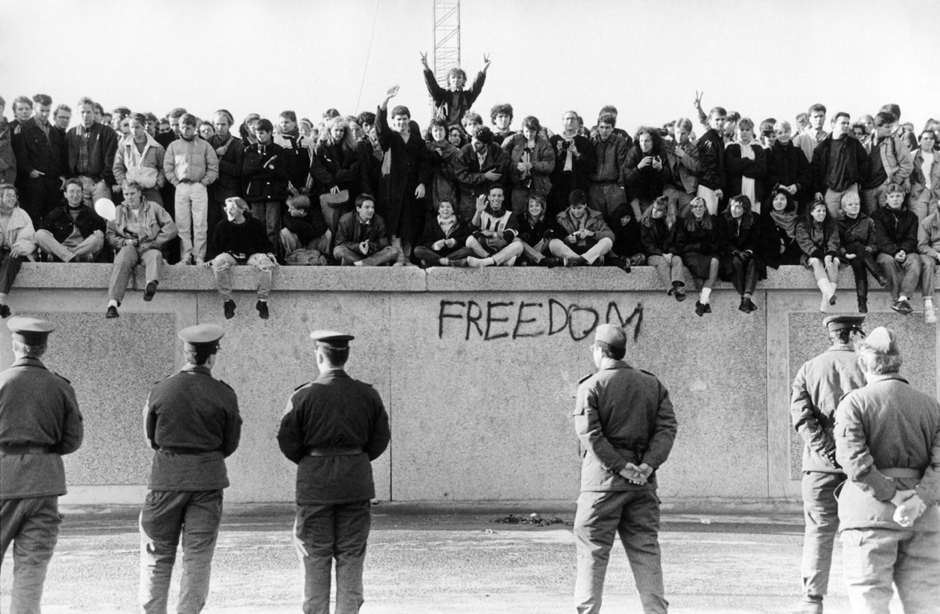
The Wall came down in 1989, and East and West Germany were reunited one year later.
Well, it just goes to show what a knowledgeable soothsayer I was. Contrary to all my expectations, the Wall came down in 1989. One year later, Nelson Mandela was released from prison paving the way for a full, democratic, multiracial general election in 1994 at which he was elected as South Africa’s president. Oh yes…in the same year, Manchester United did the Treble and Brian Lara scored 501*, the world record for an individual score in First-Class cricket. I didn’t see either of those coming either.


Comments