THE GREAT STINK

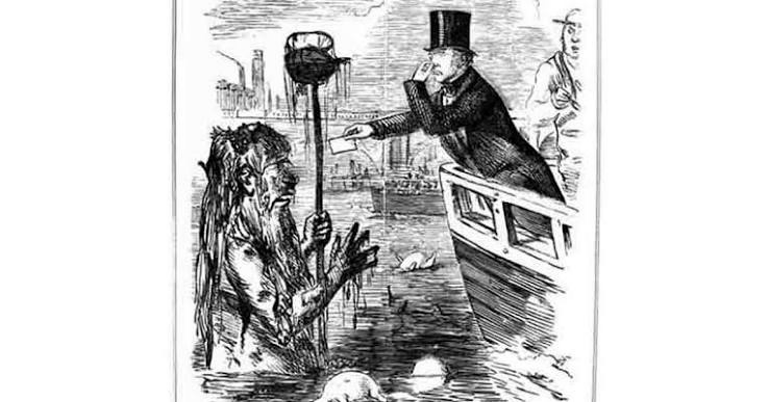
The Great Stink of the River Thames in 1858.
Recently I attended a lecture given by Professor Sir Chris Whitty at Malvern College. He is an old boy of the school; in fact, I taught him English (briefly – as a very bright boy he was swiftly promoted out of my lowly set). The subject of the lecture was the role of the state in the deliverance of public health and safety. As the Chief Medical Officer for England and the Chief Medical Advisor to the UK Government, he knew of which he spoke. During the course of his fascinating discourse – more of that later – he mentioned the name ‘Bazalgette’.

Professor Sir Chris Whitty
Bazalgette? Now where had I heard that name before? Of course – at a cricket match, well, several in fact. The Hampshire Hogs Cricket Club was formed in 1887 as one of the ‘wandering’ clubs in the country (wandering because they did not have their own ground) which provided cricket matches for “gentlemen of the military and public schools” against similar nomadic clubs. They all rejoiced in splendidly whimsical names: Somerset Stragglers, Devon Dumplings, Gloucestershire Gipsies, Wiltshire Queries, Sussex Martlets, Warwickshire Imps… You get the picture. When I moved to Worcestershire, I was prevailed upon to join this county’s equivalent, The Gentlemen of Worcestershire. In fact, in later years, I served as its chairman.

It was always the tradition that the Hogs would organise a charity match for the year’s beneficiary at Hampshire CCC and I played in many of these. A larger-than-life character in the Hogs team was a chap by the name of Christopher Bazalgette, portly of stature and balding of pate, who wore his oversized flannels held up with the colourful Hogs tie (purple, black and red) tied around the waist. He bowled donkey drops which he took very seriously indeed, taking an inordinate time meticulously setting his field.
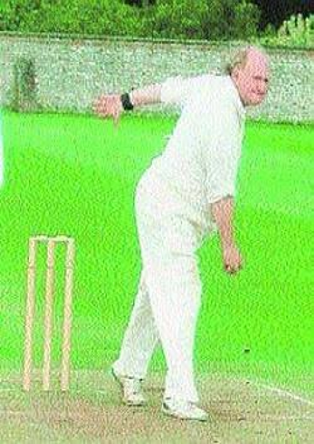
Bazalgette would snare many an unsuspecting batsman with his seemingly innocuous deliveries, backed up with strategic placing of fielders around the boundary.
“Bazalgette? Hmm, that’s French name, isn’t it?” I enquired of him at lunch.
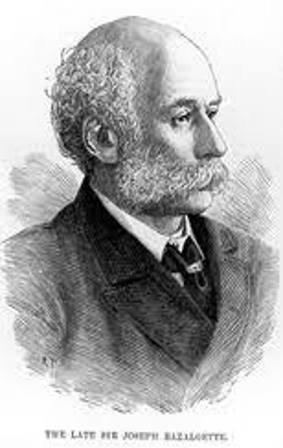
“Indeed, it is, young man,” he replied, very much de haut en bas, “My family were French Huguenots, who fled religious persecution in Catholic France in the 18th century.” He helped himself to another glass of port. “My great grandfather was Sir Joseph Bazalgette.” I must have furrowed my brow, because he expanded more on his family history. “He was a great Victorian civil engineer. Among his great public works was building London’s sewerage system for London in the mid-1800s. Still fully functional today.”
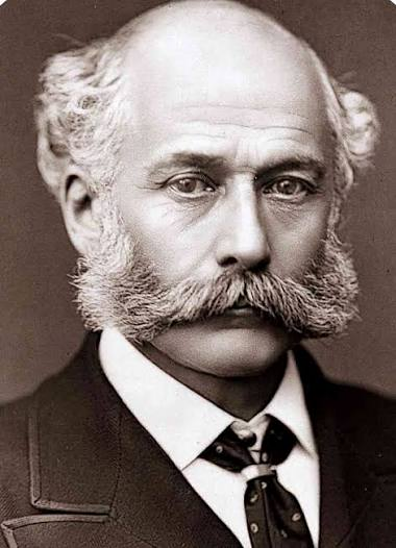
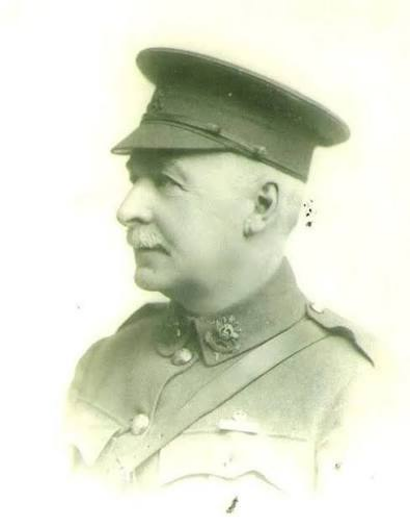
Sir Joseph Bazalgette
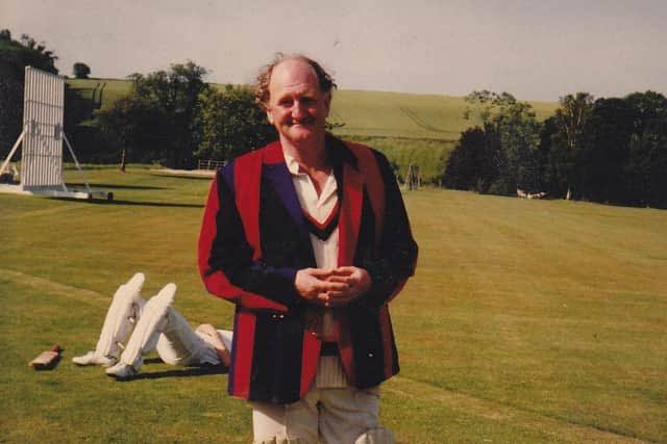
His great grandson, Cristopher Bazalgette, in his Hampshire Hogs blazer.
My interest was piqued. I did some research, much more burdensome in those days long before Google and Wikipedia. London, since mediaeval times and long before, had never been the healthiest place to live. By 1850, the population of the city had doubled to 2.5 million, and widespread adoption of water closets had sent massive volumes of untreated sewage straight into local streams that flowed directly into the River Thames. A scorching summer heatwave of 1858 exacerbated the smell of untreated human waste and industrial effluent which became unbearable. The stench was so overpowering that the Houses of Parliament closed its curtains and soaked them in chloride of lime – to little effect. Queen Victoria and Prince Albert, on taking a pleasure cruise on the river, were forced to return to shore in short order because the smell was so overpowering. The press swiftly dubbed the event The Great Stink and one daily newspaper fulminated:
“We can colonise the remotest ends of the earth, we can conquer India, we can pay the interest of the most enormous debt ever contracted, we can spread our name and our fame and our fructifying wealth to every part of the world; but we cannot clean the River Thames!”
Something must be done, went the cry.
Back to Chris Whitty’s lecture. He explained that the role of the state in intervening in the everyday lives of its citizens goes through four stages of increased compulsion, from dissemination of information to voluntary programmes to nudges and taxes and finally to rules and laws. He outlined several examples of each stage but of course it was the one about rules and laws that most caught the attention. Some notable events in our history stood out.
In mediaeval times, during the Black Death, fourteen days of quarantine (the word comes from the Italian quaranta giorni, which means ‘forty days’, which was the original period of quarantine) was required for people travelling from infected areas.
In 1875, an Act was passed that prevented children under the age of 10 being sent up chimneys to sweep them.
In 1952, the Great Smog of London prompted the passing of the Clean Air Act of 1956.
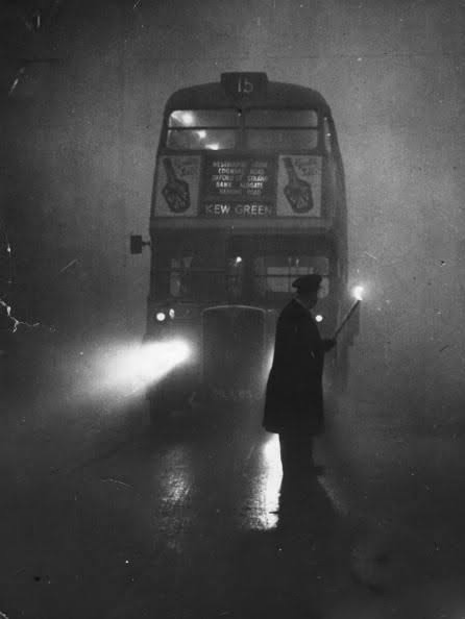
I remember the pea soupers of the 1950s. We rather enjoyed them because we were sent home early from school. Some 4,000 Londoners who died in the Great Smog of 1952 would not have been so blasé.
In 1983, the compulsory wearing of seat belts in cars came into force. (Was it only forty odd years ago?)
In March 2020, at the height of the Covid epidemic, the prime minister, Boris Johnson, announced to the nation that we all must stay at home to protect the NHS and to save lives.
These were some of many occasions when the state has laid down the law to its citizenry for its own safety and well-being. The Great Stink of 1858 was another case in point. This is when the name Bazalgette came up in Whitty’s lecture. At that time, huge amounts of human and industrial waste were pouring into the River Thames, which was also the main source of the city’s drinking water. This was triggering devastating waterborne cholera epidemics, and the Great Stink was the breaking point. Something must be done, had been the cry, and something was done.
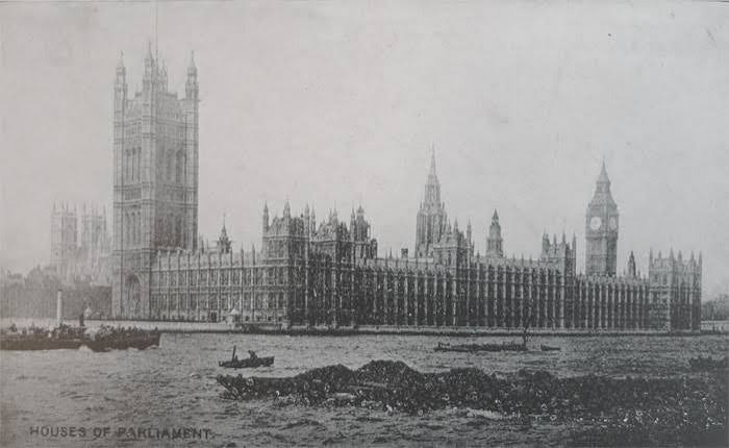
The Great Stink of 1858 disrupted Parliament. “Something must be done!” reverberated around its corridors.
Sir Joseph Bazalgette was the Chief Engineer of London’s Metropolitan Board of Works, and with funding agreed by Parliament, he was tasked with designing and building the city’s first comprehensive underground sewer network. His blueprint consisted of 1,300 miles of sewage pipes and 82 miles of east-west intercepting sewers. With considerable foresight, their circumference was built to twice the size that current demand needed. You can only build these once, he said, and capacity is only going to increase. He was spot on there; his sewage system is still fully operational today. To cope with the waste, he built a number of huge pumping stations, so gaudily decorated that Londoners referred to them as the Cathedrals of Sewers. He also embanked the river in central London, reclaiming 52 acres of land, the Victoria Embankment, the Albert Embankment and the Chelsea Embankment, all safely enclosing the main sewers, as well as gas mains and the early lines of the Underground.
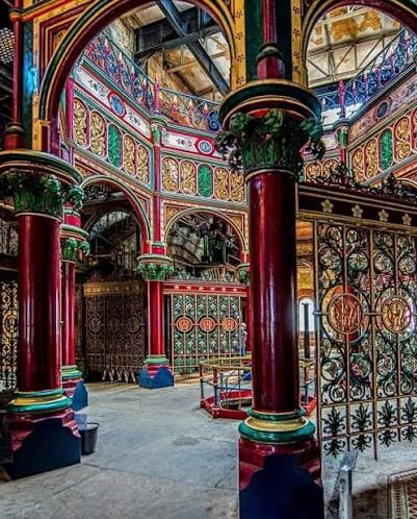
You can see why the gaudily decorated pumping stations were known as the Cathedrals of Sewers. This one is in Crossness, Bexley, in south-east London.
In fact, the impetus for building the new sewerage system was based on a false premise. Current medical thinking at the time was that the cholera outbreaks were caused by ‘miasma’, a highly unpleasant and unhealthy smell, but of course we now know that cholera is spread by contaminated drinking water. The unintended consequence of the new sewers was that the causal bacterium for cholera was removed from the water supply, thus largely eliminating outbreaks of cholera and typhus.
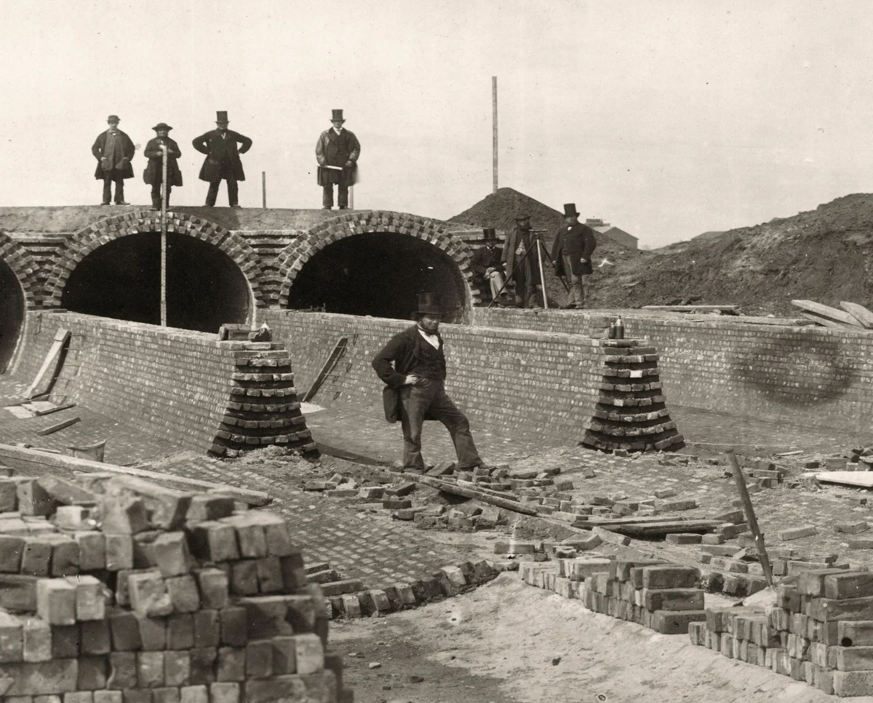
Bazalgette – hands on hips in the background – supervising work on his sewerage system.
The new system was opened by the Prince of Wales, the future King Edward VII, in 1865 though the whole project was not completed for another ten years. A workaholic, Bazalgette did not sit on his hands once his dream of the sewerage system had been realised. He worked on repairing many of London’s bridges, replacing three, Putney Bridge, Hammersmith Bridge and Battersea Bridge, with new structures of his own design. He also set about easing the capital’s congested horse-drawn traffic flow by building new roads, Southwark Street, Queen Victoria Street, Northumberland Avenue, Shaftesbury Avenue and Charing Cross Road. Furthermore, he oversaw the acquisition of open spaces to become public parks – Battersea, Kennington, Ravenscroft, Dulwich and Finsbury, as well as Clapham Common and Blackheath Common – each surveyed by Bazalgette, including being involved in their draining and landscaping.
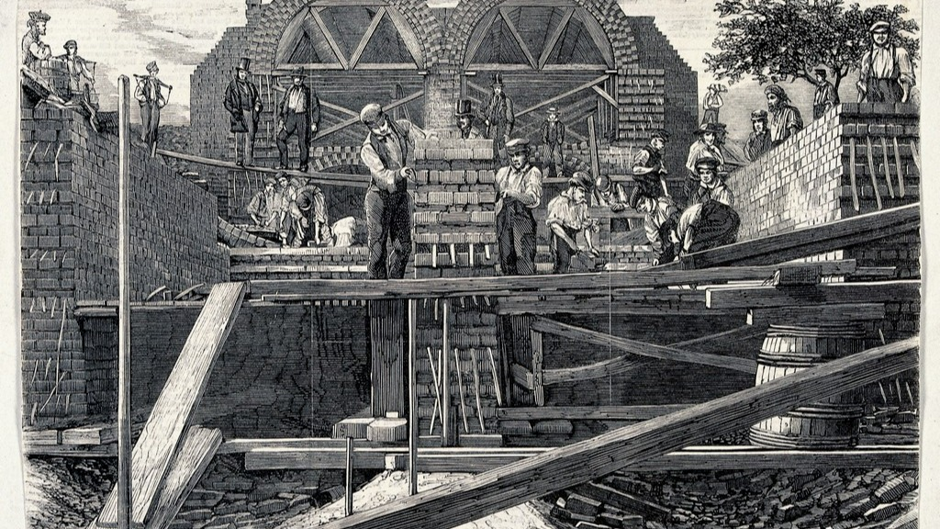
In all 1,300 miles of sewer pipes were built.
He was knighted by Queen Victoria in 1875 and died in Wimbledon in 1891, two years after his retirement.
And what of our evergreen troubadour of English club cricket, Sir Joseph’s great grandson, Christopher Bazalgette? It has been argued in some circles that he was probably one of the most prolific of amateur cricketers. He played for a number of clubs apart from the Hampshire Hogs and is believed to have taken over 2,500 wickets in his long and varied career. For the Hogs alone, he took 1,405 wickets before making his final appearance for the club in 2017, having played in over 800 matches. He died in 2023. “We shall not see his like again,” one mourner at his funeral said.
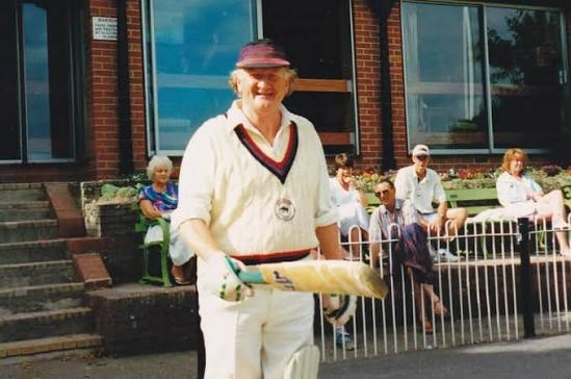
Christopher Bazalgette batting for his beloved Hampshire Hogs Cricket Club.
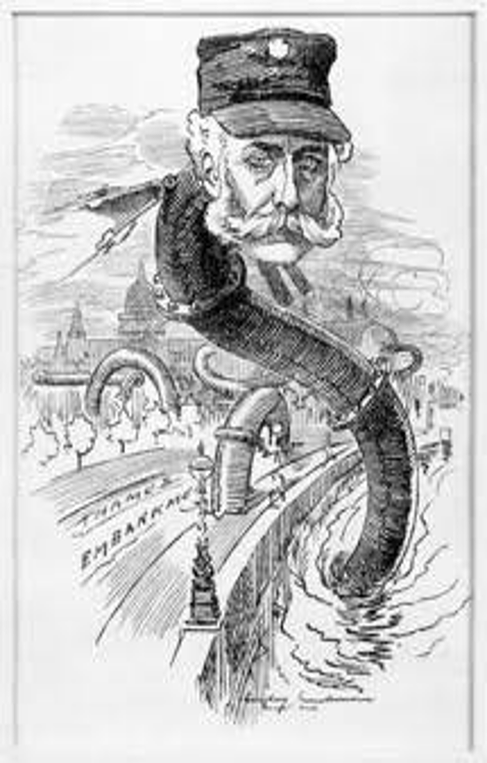
‘The Sewer Snake’ – Punch’s cartoon of the great civil engineer.

The construction of the Thames embankment between Waterloo and Blackfriars 1865
“The principle of building a sewer system is to divert the cause of the mischief to a locality where it can do no mischief.” (Sir Joseph Bazalgette)


Comments